"AI Overview
Learn more
The phrase “like a moon in a dewdrop” is a Zen Buddhist metaphor, often used in the writings of Zen Master Dōgen, to describe the nature of enlightenment and realization, where the vastness of the moon (representing enlightenment) is reflected in the smallness of a dewdrop (representing all things).
Here’s a more detailed explanation:
The phrase “moon in a dewdrop” is a powerful image that illustrates the idea that enlightenment or the true nature of reality is not something vast and distant, but is present and accessible in even the smallest and most ordinary things.
In Zen Buddhism, the moon is often used as a symbol of enlightenment, while dewdrops represent the world of experience and the individual’s self.
Zen Master Dōgen, a prominent figure in Japanese Zen Buddhism, frequently used this imagery in his writings, particularly in his work “Moon in a Dewdrop: Writings of Zen Master Dōgen”.
Some interpretations of the “moon in a dewdrop” metaphor also suggest that the true nature of reality is timeless and that enlightenment can be experienced within the context of everyday life."
4 Likes
" AI Overview
Learn more
In Buddhist teachings, “84,000 defilements” refers to the numerous negative mental qualities or “kleshas” that obstruct enlightenment and lead to suffering, with the 84,000 categories of the Buddha’s teachings serving as the antidote.
Here’s a more detailed explanation:
- What are “defilements” (kleshas)?
In Buddhist psychology, “kleshas” are negative mental states or afflictions that obscure the mind’s natural purity and lead to unwholesome actions and continued existence in samsara (the cycle of rebirth).
This number is not meant to be taken literally, but rather as a symbolic representation of the vastness and complexity of these negative mental qualities.
Common examples include greed, hatred, delusion, attachment, anger, and ignorance.
- The Buddha’s teachings as the antidote:
The 84,000 teachings of the Buddha are seen as the means to overcome these defilements and attain enlightenment.
“Kleshas” are also translated as “negative emotions,” “disturbing emotions,” or “stains”
4 Likes
Five wisdoms (Tib. ཡེ་ཤེས་ལྔ་, yeshe nga, Wyl. ye shes lnga) — five aspects of primordial wisdom (Tib. ཡེ་ཤེས་, yeshe). They are as follows:
- wisdom of dharmadhatu
- mirror-like wisdom
- wisdom of equality
- wisdom of discernment
- all-accomplishing wisdom
3 Likes
" AI Overview
Learn more
In Buddhist Mahayana tradition, the “truth body” (Dharmakaya) is the ultimate, absolute reality, while the “emanation body” (Nirmanakaya) is the Buddha’s manifestation in the world to teach and guide beings.
Here’s a more detailed explanation:
4 Likes
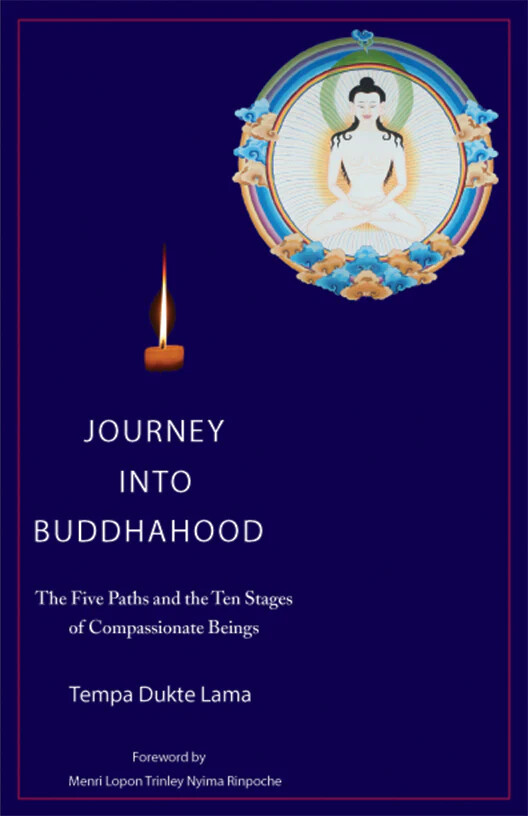
" Journey into Buddhahood offers a profound guide to attaining full liberation according to the Bon Sutra path, the path of compassionate beings. This journey begins with the aspiration to attain awakening in order to help all sentient beings gain freedom from cyclic existence. The journey consists of five successive paths. On the Path of Accumulation we gather merit and wisdom to help us overcome the two delusions that obscure our true nature. These are the delusion of affliction, which consists of afflictive emotions and afflictive views, and the delusion of intellect, which is the grasping at the self and phenomena as real and substantial. Tempa Lama’s book offers a detailed explanation of these two delusions and how we can gradually transcend them through practicing the Thirty-seven Aspects of Enlightenment. On the second path, the Path of Application, we prepare for the direct recognition of the nature of reality. On the third path, the Path of Seeing, we attain a direct recognition of the true nature of the self and phenomena for the first time. This recognition is deepened and stabilized on the subsequent Path of Meditation. Finally, the compassionate being attains liberation on the Path of No More Learning or full Buddhahood."
Journey-Contents_Foreword_Intro.pdf (shopify.com)
Journey into Buddhahood: The Five Paths and the Ten Stages of Compassi – Olmo Ling Store
3 Likes
“The Universe orchestrates the perfect sequence of events to bring your desires into reality.”
Yes!
If your desires are in harmony with the Tao.
3 Likes
Yes, it’s a whole  a dance in which there is song playing you, not anymore you playing a song
4 Likes
Yes! You’re not playing the song, the song is playing you! I love that!
4 Likes
" SLOGAN 11 •
When the world is filled with evil, transform all mishaps into the path of bodhi."
4 Likes
" * Six Perfections (Pāramitās):
These are the six virtues or qualities that bodhisattvas strive to develop on their path to enlightenment, including:
- Generosity (Dana): Giving freely and without attachment.
- Morality (Sila): Living ethically and with integrity.
- Patience (Kshanti): Enduring hardship and adversity with equanimity.
- Diligence (Viriya): Effort and perseverance in one’s practice.
- Concentration (Samadhi): Mental focus and mindfulness.
- Wisdom (Prajna): Understanding the true nature of reality.
"
3 Likes
Quantum Light Breath by Jeru Kabbal
@fenwizard do you know him?
@YelienaT he lives in Hawaii…
@NightHawk999 think you’re gonna love this video!


3 Likes